


Ocean Survivors
Your ship doesn't scale. Your decisions do.
Ocean Survivors is a pirate-themed survivors-like roguelite where you navigate a ship through escalating enemy fleets for roughly 15 minutes per run. You unlock weapons and abilities each playthrough, adapt your build to random upgrade choices, and compete on global leaderboards. No permanent progression—each run starts fresh.
Ocean Survivors sells its 15-minute loop on a paradox: it positions itself as stripped-down and fair-priced, but players are drawn to it because the power-up combinations and tight ship controls make each run feel genuinely different, not just shorter.
Across reviews, the $2–3 price point is mentioned as enabling risk-free discovery; players consistently frame purchases as impulsive decisions that exceeded expectations, suggesting price transparency directly increases engagement rather than triggering value skepticism.
The analyzed reviews treat the 15-minute run length as a feature, not a compromise. Players describe locking in for multiple sessions in a single sitting and using it as background entertainment while multitasking, indicating the format solves a specific scheduling problem in roguelite design.
Control feedback and power-up theming emerge as the core loop drivers. Multiple reviewers emphasize the satisfaction of tight ship maneuvering and the experimentation incentive created by thematic, varied upgrades rather than generic stat scaling.
The primary barrier in the analyzed reviews is environmental and mechanical variety. Several players note that the single map with the same enemy types across runs limits longevity, even within the intended play window. One reviewer expressed disappointment that beyond unlocking abilities, the core challenge stays static. The game is explicitly made to be finished in 3 hours of total playtime, but a few players found themselves reaching that ceiling before unlocking enough weapon combinations to sustain engagement. This is not a bug or design flaw—it's the consequence of a deliberately contained scope. Players who want more thematic variation (different ocean environments, enemy factions, or visual settings) identify this as the logical next step for long-term appeal.
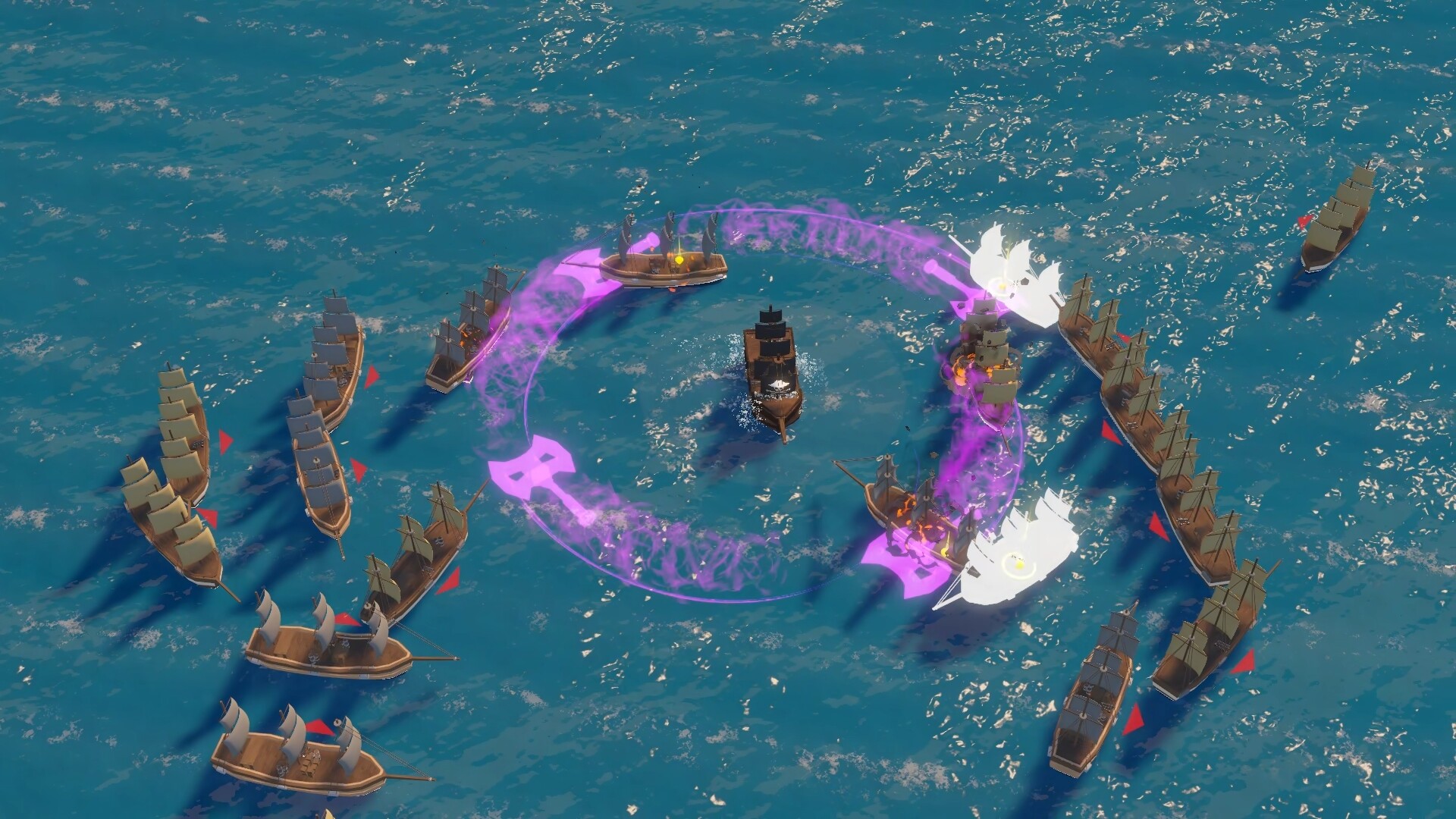
Ocean Survivors is a bite-sized, pirate-themed survivors-like focused on skill and tactical upgrades rather than permanent progression. It features score-attack and roguelite mechanics designed to be completed within roughly 3 hours total, with no endless grinding.
Players frame it as a surprisingly deep pickup game with genuinely satisfying controls and thematic power-ups that change how you approach each run. The price is mentioned almost always as a sign of exceptional value, and the 15-minute format is positioned as respectful of player time, not limiting. Community language emphasizes the replayability loop and leaderboard as motivators without framing them as obligatory.
“I mean, it's fun, it runs smoothly, it has ships and it costs 2 bucks, I can't imagine giving this a negative review :D.”
“Ocean Survivors is a visually stunning and endlessly replayable survivors‑style adventure, gorgeous water effects, a huge variety of weapons that feel great to use, and run‑to‑run variety that keeps every session fresh and chaotic.”
“The ship shoots from its sides, so that alone has you constantly engaged on how to best shoot at enemies while also avoiding their shots.”
“It definitely has its own identity while still feeling like a roguelike bullet hell.”
Short verbatim excerpts selected from the analyzed public Steam review sample for their relevance to the analysis above.
19 public Steam reviews analyzed across 3 languages.
Synthesized from public Steam reviews. Not affiliated with Valve Corporation.
Player-language signals, not generic review scores.
Best for
- —Casual strategy players looking for a roguelite that respects the 20-minute session window.
- —Leaderboard-focused arcade players who want global competition without seasonal gating or season passes.
- —Steam Deck owners seeking a game designed for handheld play that doesn't demand constant focus or fast reflexes.
More games with overlapping community patterns.



Deep editorial analysis
The gap between Ocean Survivors' official positioning and how players actually talk about it is instructive. The developer emphasizes no-grind, skill-based design and leaderboard competition. Accurate, but incomplete. What keeps players returning is something more specific: the feedback loop between weapon upgrades and enemy chaos. Power-ups here aren't just stat boosts. They're thematic, directional, and they dramatically reshape how you play. A review notes the power-ups are incredibly unique and thematic, making each run much more dynamic. Another describes locking in for hours while watching something else, which is not a complaint—it's admission that the game nails the pick-up-and-play rhythm without asking for constant attention.
The control design amplifies this. The ship shoots from its sides, forcing you to constantly reposition while gathering loot and dodging incoming fire. One player who switched from keyboard to controller found the tight maneuvering satisfying once acclimated. This isn't precision that punishes; it's precision that rewards learned muscle memory. The 15-minute frame isn't a limitation. It's permission to make every session feel complete rather than a checkpoint on the way to something larger.
Price is mentioned in 48% of reviews, but almost always as a setup for surprising value, not complaint. Players bought on a whim, expected an hour or two, and found hours of experimentation. The leaderboard exists, but the analyzed reviews frame it more as a confidence check than a grind target. At $2–3, Ocean Survivors avoids the tension between content-per-dollar and play-per-session that haunts bigger roguelites. It's short enough to finish before you get bored, long enough to unlock meaningful choices.
Signal data
% positive reviews
Under-the-radar potential
Store framing vs player language
Voice and personality in reviews
Would a stranger click buy?
30 reviews currently indexed
19 analyzed · english, koreana, russian
Last synthesized: Aug 18, 2026 · 19 reviews in that synthesis
Revlize indexed this signal before it reached scale.
8/18/2026 · 29 reviews
30 reviews
+3% · +1
Why it entered the radar: niche breakout.
This timeline records correlation only. Revlize does not claim to have caused later growth.
Review sampling, evidence boundaries and public-signal methodology.
Frequently asked
The game emphasizes tactical decision-making and ship control over extreme reflexes. It's designed for pick-up-and-play, especially on Steam Deck. Players report the responsive controls feel best with a controller, though keyboard is playable after acclimation.